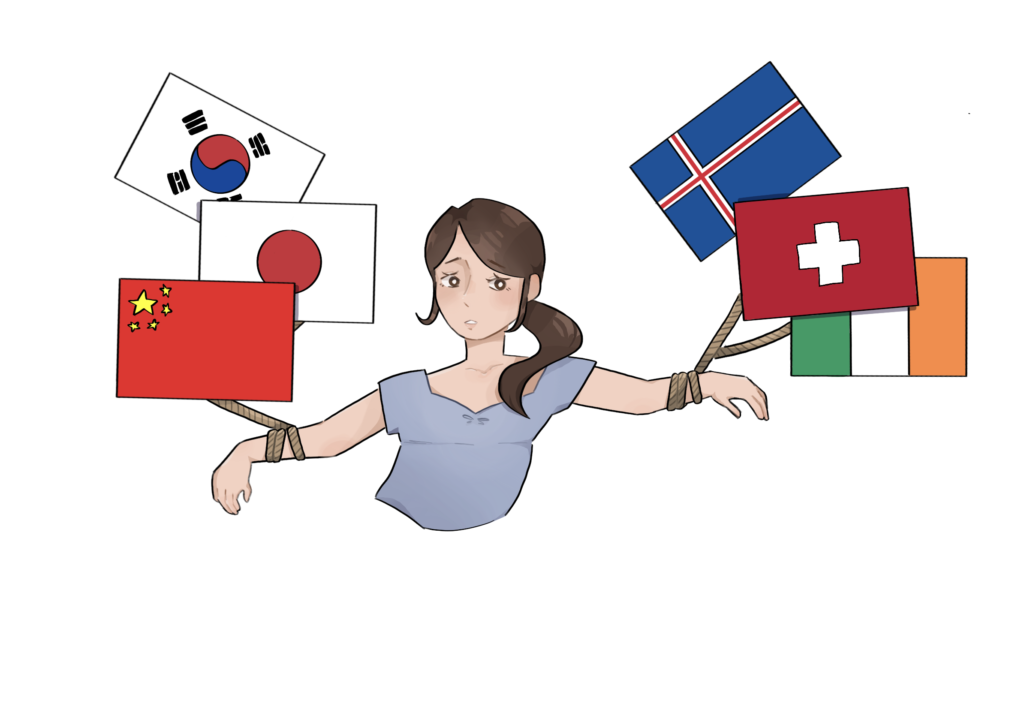
The growing population of Wasians in the United States has been reflected in Gen Z and Gen Alpha media, with their representation coming to life in the Bay Area, including at Aragon.
According to the 2020 Census, 2.7 million people in the U.S. identified as both Asian and White, increasing by 65.8% from the 2010 Census. This increase in the Wasian population has made highly populated areas of Asians more diverse and has created a plethora of mixed cultures and traditions.
Although this new abundance of diversity is refreshing to many, alienation and insensitivity towards biracial people, specifically biracial Asians, have still found their way into the lives of many.
“In the Bay Area, you’re treated like a normal person,” said junior Johanna Norman. “[Being Wasian is] so common [here] that no one really bats an eye. But outside of the Bay Area or California, I see this problem a lot with older people [where] they’re like, ‘you’re so exotic, you’re so interesting.’ They treat you like you’re a fancy cat breed.”
For many biracial Asians, feeling representative of their cultures is a hassle, because being mixed-race also means looking mixed-race. So for many, being able to identify with one of their cultures just through physical appearance isn’t an option.
“I’ve grown up in a pretty Japanese-American community, but a lot of people kind of can’t tell that I am half Japanese when they see me,” said junior Nina Taylor. “They act really surprised when they find out how I’ve been raised and that I do speak some Japanese and celebrate a lot of Japanese culture.”
Because of the increasing population of biracial Asians, and specifically Wasians, in the Bay Area, a surplus of different judgments and portrayals has risen. Although Wasians have had a sudden jolt of popularity in the media with figures like Alyssa Liu, many report that most don’t accurately represent biracial Asians.
“I haven’t seen any representations of mixed people in media, but maybe that’s because I’m not looking hard enough, or I can’t tell if they’re mixed,” Norman said. “There are few [TV] series with mixed representation, but other than that, I don’t feel [very] represented in major media.”
Others argue that the representation of Wasians and biracial Asians doesn’t portray figures who are in tune with or embracing both cultures.
“Sometimes people say they’re both [Asian and White], but they can only speak one language, and they can’t find the balance in that,” said senior Mia Gottschalk. “But when people are portrayed like that in the media, it sounds a bit hopeless. There should be more hopeful opportunities for [others] to learn their language or learn [the] other half of [their] culture.“
For Gottschalk, being in touch with both sides of her heritage comes easily due to her knowledge of language. However, others struggle to express both cultures that they identify with, especially if they are not a mix of white, such as senior Tyler Rivera.
“Compared to my Mexican friends, I don’t know that much Spanish,” Rivera said. “And compared to my Asian friends, in terms of their own language, I personally know very little Korean. It’s disappointing [for me] because whenever I introduce myself, they ask, ‘oh, do you know how to speak Spanish?’ [or] ‘oh, do you know how to speak Korean?’ I’m just like, ‘no, I don’t speak [either].’”
Rivera has grown up on a different side of many biracial Asians in the Bay Area. Being in the minority of this already small demographic has made his experiences and perspective even more unique.
“Outside of myself and maybe one other, I don’t know very many Asian and Hispanic people,” Rivera said. “With such [a] little amount of people in the community, the representation [is] already smaller, but it is a community that should be brought to light more. All [the] experiences of these multicultural people are very unique, and it’s very important to understand how they fit in.”