Mi Nguyen
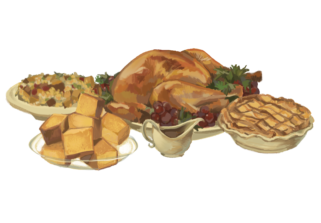
On the fourth Thursday of every November, families set their tables with succulent turkeys and scarlet-red cranberry sauce, amongst many other traditional dishes.
It’s Thanksgiving, that time of year when families and friends gather to celebrate and reflect on the perilous journey to North America. The holiday symbolizes the hope European settlers had: the yearning for freedom.
The holiday has its origins from a 1621 feast that lasted three days, celebrating the new relationship between the Pilgrims and the Wampanoag, the native tribe of Plymouth.
Abraham Lincoln established Thanksgiving as a federal holiday in 1863, more than two centuries after the initial feast, in the midst of the Civil War. His ideals of national unity inspired him to establish Thanksgiving as an annual tradition and symbol of togetherness, even though the country was divided between the Union and Confederacy.
Today, Thanksgiving has become a holiday with lavish dinners celebrated by millions in America. According to a United States Department of Agriculture poll, compared to other holidays, Thanksgiving consistently ranked the highest among young adults for two major categories: meal prep and cleanup — almost three times higher than the next closest holiday — and eating and drinking, which was almost two times higher.
Thanksgiving is a time-consuming, food-based holiday, where families spend hours planning mesmerizing visuals and flavorful dishes. As a result, a sense of pride is instilled in the holiday, as people want their efforts to be noticed and cherished by others.
Many cultures around the world blend Thanksgiving with their own traditions, demonstrating that togetherness has a positive and long-lasting effect on the way the holiday is celebrated today.
“I’m usually with family having hotpot on Thanksgiving,” said senior Sophia Tiu. “It’s a fun way to combine [Asian] and American culture.”
However many have acknowledged that there was a darker side to the story of Thanksgiving: the harmful impacts European colonists had on the Indigenous population.
“There was forced assimilation when [Native American] children [were] forced to fit the [European] societal norms,” said junior Dimitri Cooper. “There was immense displacement and physical and cultural violence [towards the Natives].”
European settlers introduced devastating new diseases to the Natives and were notorious for exploiting Indigenous peoples. Some argue that the holiday fails to acknowledge this controversial history and shouldn’t be revered so highly.
“The origins of Thanksgiving that we learn [about] isn’t the whole story,” Tiu said. “[The story] takes away [from] the [Europeans’ abuse] of kindness and it wasn’t [actually] as peaceful.”
Colonization is inherently unjust and the settlers’ actions are unforgivable. Their centuries-long mistreatment of Native Americans cannot be ignored.
However, celebrating Thanksgiving and recognizing the history of continued damage towards the Indigenous peoples are not mutually exclusive. The intention of Thanksgiving is not to glorify colonization; rather, it honors the generosity of the Native Americans and the settlers’ gratitude towards them.
The past damage to Indigenous people cannot be undone, but only remembering that part of history takes away from the main message of the holiday: it’s a time for people to set aside their differences, share a few smiles and be grateful for their loved ones.
Thanksgiving can still be celebrated, though a greater emphasis on understanding the holiday’s history should also be established.
“If we [dismantled] Thanksgiving, people would get upset,” Cooper said. “As a society, [we’d be] going too far to be considerate of others. It’s important to understand the history of [America] by educating people about the real story behind Thanksgiving.”
Moreover, other holidays, like Christmas, have been detached from their origins by the general public. First originating as a Christian holiday, Christmas is now enjoyed by many non-Christians, and according to the Associated Press-National Opinion Research Center, 48% of Christmas observers view the holiday as a non-religious cultural celebration.
As with Christmas, the public can acknowledge the history and backstory of Thanksgiving while also continuing to celebrate it.
Voiding the widespread holiday would eradicate a day of gratitude and mindfulness. It would also go against the morals of our previous generations, who fought numerous wars in order to build a country where everyone could live in harmony.
As one of the nation’s oldest traditions, Thanksgiving shouldn’t be forgotten about. It carries familial significance and is an acknowledgement of those who lost their lives in pursuit of a better future. Due to its ability to unite in growing times of division, it should remain a widely-recognized holiday.