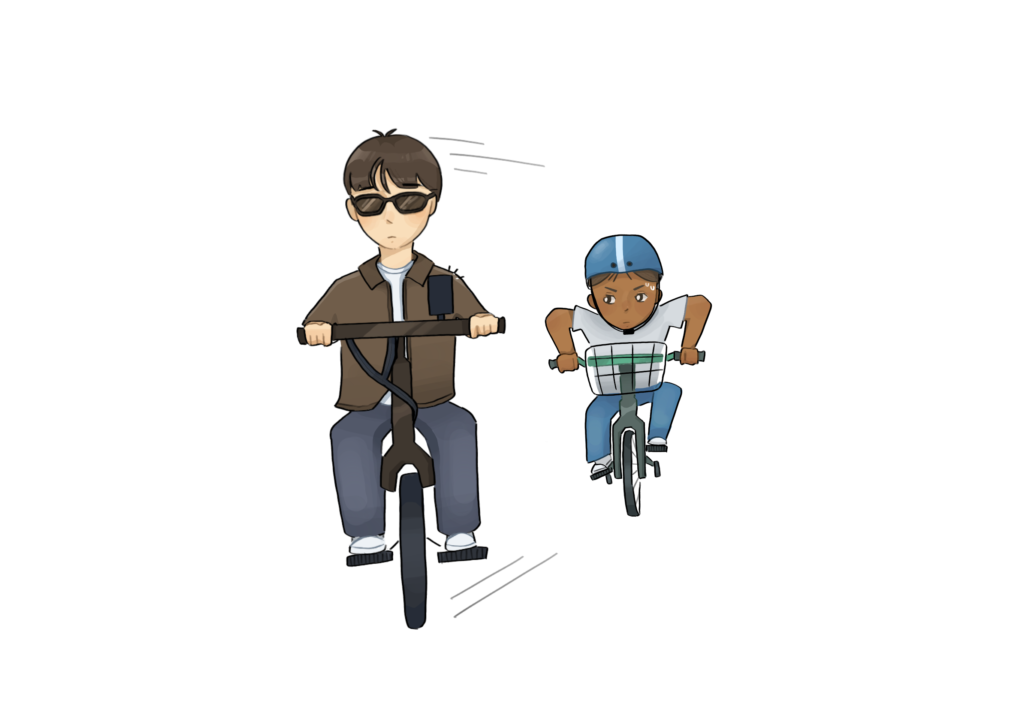
On Sept. 30, Gov. Gavin Newsom signed three laws addressing e-bike safety, including one which gives San Mateo County the option to be the first in California to ban children under 12 from riding e-bikes. Municipalities in the county are in the process of deciding whether or not to implement the ban for San Mateo youth.
Assembly Bill 2595 authorizes local authorities in San Mateo County to ban children younger than 12 from riding Class 1 and Class 2 e-bikes, which can go up to 20 mph with motor assist, a function that turns on the motor of the e-bike when the rider pedals. Violators are fined $25 but can take an electric bike safety program in lieu of paying the fine.
“I would much rather kids use traditional bikes over e-bikes,” said Foster City Councilmember Stacy Jimenez. “It’s better for your health, it’s better for the environment. The batteries that come with the e-bikes are very dangerous … The fire department is reporting a huge increase in the number of fires related to [lithium ion] batteries, [which e-bikes use].”
Children under 16 are already prohibited from riding Class 3 e-bikes, which can travel up to 28 miles per hour.
“[Restricting e-bikes] is very situational because of course there’s a very wide spectrum of e-bikes,” said junior Liam Persson. “And for certain ones, like a pedal assist bike, a 12-year-old could ride that fine, it’s like a normal bicycle. If you ride a full [e-motorcycle] … [there] definitely need to [be] restrictions; someone under 12 shouldn’t be riding one of those.”
These new laws come in response to the deaths of two young children in bike collisions. In one of these incidents, which took place in Burlingame, a car fatally hit a four-year-old child after colliding with an 11-year-old on a Class 2 e-bike.
This is part of a larger trend of rising e-bike collisions, with collisions increasing in California from two in 2018 to over 1,500 in 2024. Additionally, children under 14 years old had the highest recorded number of e-bike injuries.
“I personally have seen a lot of reckless riding coming from younger kids in middle school,” Persson said. “Like not wearing a helmet and just kind of fooling around on the bike. That’s just a stupid thing to do. I could see why they’re putting restrictions towards kids like that.”
However, some officials are concerned about how the ban could realistically be enforced in the local residential area.
“If we were to enact a ban on e-bikes for anyone under 12, you are immediately going to have issues with officers trying to figure out whether or not someone who appears to be young is actually young,” Jimenez said. “And it’s not like 12-year-olds are carrying around driver’s licenses or IDs that state accurately how old they are. So, it’s definitely difficult to be able to profile someone easily.”
Additionally, some believe that more accountability should be placed on car drivers when near bikers or pedestrians.
“A lot of times, the accidents that I hear about are because of a driver,” said Maggie Trinh, President of the San Mateo-Foster City School District Board. “It’s not because a rider was doing something reckless, which is a common narrative … It’s easy to get online and complain about teenagers on e-bikes, just as people used to complain about teenagers on skateboards … Making infrastructure that is safe for everyone is what our focus should be on, and not necessarily this very narrow restriction on e-bikes for under 12-year-olds.”
Similar programs for older teenagers were approved in San Diego and Marin counties. Marin County’s pilot program, which began in July of 2025, prohibits Class 2 e-bike usage for those under 16. Since then, e-bike accidents among children aged 10-15 years dropped from 16.25 in 2026 to 11.65 in 2024 per 10,000 residents.
“Marin has a whole system of bike trails,” said math teacher Craig Sipple. “So they were having issues with kids [thinking], ‘How fast can I go?’ A lot of times, these paths are shared paths [with] pedestrians … so they had issues of people getting hit. This [law was only created because] people get hurt.”
Another one of the new state laws mandates manufacturers and distributors of vehicles faster than e-bikes to disclose
that they are motor vehicles and prohibits them from selling them as e-bikes. According to the San Jose State University’s Mineta Transportation Institute, many of the accidents attributed to e-bikes actually involve faster vehicles that legally aren’t e-bikes. In fact, as few as 12% of electric two wheelers parked in California schools may be legal e-bikes.
“Kids don’t care if that’s an ebike or an e-motorcycle,” said senior Ryan Liang. “They’re gonna see that e-motorcycle and think, ‘that one’s cooler. I want that one.’ They’re not gonna know that thing is much faster, much more dangerous for them. The law is going to be needed to prevent any accidental buying.”
Lastly, Assembly Bill 2346 requires Class 2 e-bikes to have speedometers and all e-bikes to have front and rear lights. The bill also requires sellers to make clear the maximum speed of the e-bike and sets a speed limit of 10 mph on sidewalks.
“You definitely need some lighting to alert people much better that you’re approaching during a darker situation like in a tunnel or at nighttime,” Liang said. “Because I biked at night, [and] that was incredibly scary to do. It’s hard to see what’s in front of you, and hard for people to see if you’re coming, especially if you don’t have flashing lights.”
According to Jimenez, the City and County Association of Governments, which is a board of all cities in San Mateo County, will develop a set of guidelines to help cities have the same rules regarding the potential pilot program as they begin to discuss restricting children’s ability to ride certain e-bikes.