Eden Kwan
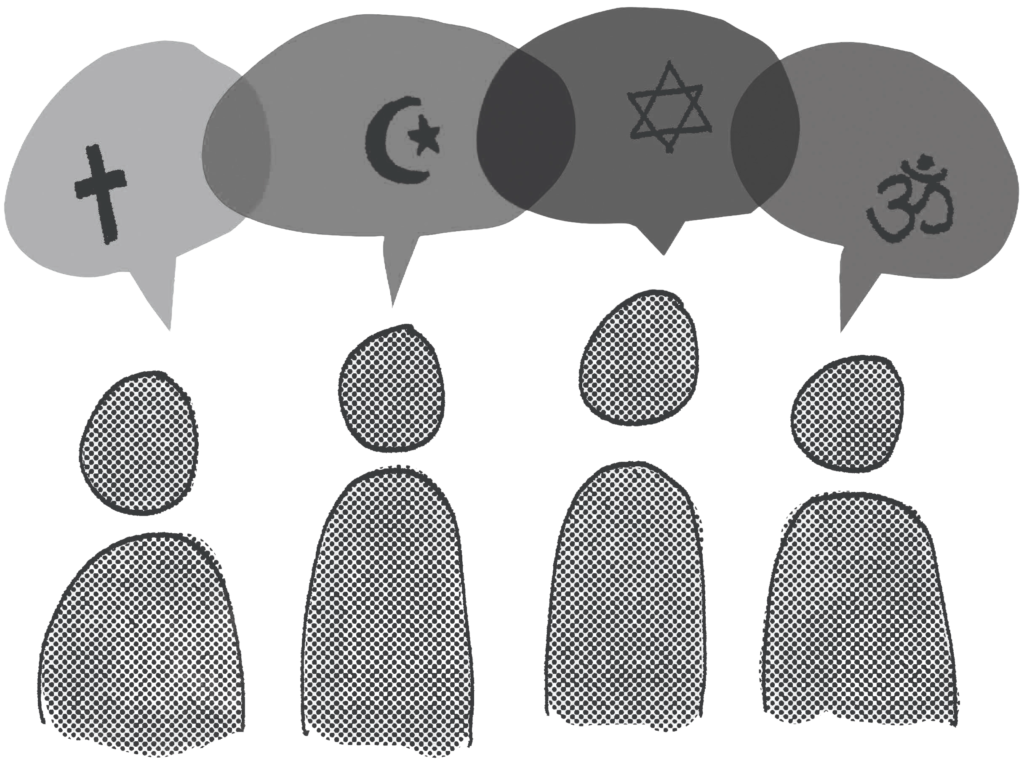
“Love thy neighbor” is a phrase from the Bible that argues kindness and connection should come before differences. In reality, relationships are often more complicated. From friendships to romantic partnerships, faith can both unite and divide, communicate and draw boundaries.
Religion is a powerful force that guides people’s decision-making indirectly through upbringing and environment, affecting how one can approach relationships.
“The biggest thing with Judaism [is that it’s] really family‑focused and really community‑focused,” said senior Evan Westheimer. “The whole religion is surrounded by that idea … Judaism taught me that in romantic relationships, having strong family values is really big for me.”
Religion simplifies relationships by giving people built-in common ground. When people share a belief system, it offers a shared purpose that streamlines relationships beyond lifestyle and prayer. It can create an immediate sense of understanding, which makes it easier to form deeper connections.
“I have some very close friends who I’ve met in church, and one of the primary things we bond over is our faith,” said senior Samuel Young.
However, differences in religion can create misunderstandings, which can prevent people from truly understanding one another. For many religious communities, especially more traditional ones, this structure shapes expectations for behavior in relationships. Religion in these cases then works as a social framework that defines what kinds of relationships are accepted.
“My grandparents would not be as understanding [toward interfaith marriage], because they’re so rooted in their … traditional values: marry within your religion, marry within your nationality,” said junior Yash Seth.
Avoiding discussion about religion is just one way students maintain relationships, like friendships, despite differences.
“We mainly kept religion out of the conversation,” Young said. “With more conservative individuals, [religion] may take a very large role.”
While this approach may reduce conflict, it can also limit deeper conversations. These unspoken guidelines become more significant as time goes by, especially as relationships grow more serious and questions regarding future lifestyles become harder to avoid.
“A big challenge [in interfaith relationships] is knowing what faith, what customs, what practices, what holidays you want to celebrate, [like] what you want to base your lifestyle around,” Westheimer said.
Furthermore, when one belongs to a less visible or marginalized religious group, these differences can feel prominent.
“When I was younger, I was not really proud of being Hindu, because everyone else around me was either Christian or Muslim,” Seth said. “I felt like an outsider. [My peers] sometimes joke around when they’re eating beef; they’re like, ‘Oh, look at me, I’m eating beef and you’re not.’”
Dietary preferences, while seemingly straightforward, often represent broader lifestyle choices. When there is a lack of understanding of differences, students may be more likely to pursue same-faith relationships.
“I probably wouldn’t [be in an interfaith marriage] just because I want my kids to grow up the way I grew up and I would want my household to have all the same values, traditions and beliefs,” said junior Ayah Atawneh.
Apart from romantic relationships, students approach differences in friendships by emphasizing respect. Engaging with difference thoughtfully in these cases doesn’t dilute tradition, but can strengthen one’s understanding of it.
“Instead of … shaming the [nonreligious people in my life], I’m gonna love them no matter what they say to me, what they believe in,” said junior Jaclyn Ruttenberg. “[But them] challenging me [also] helped me grow a lot in my faith.”
Overall, religion is a grounding force for students, functioning as a source of shared stability despite people’s differences. How individuals respond to religious differences depends on whether they perceive faith as a shared foundation or a cultural boundary. Often, it is both.