Lillian Huang
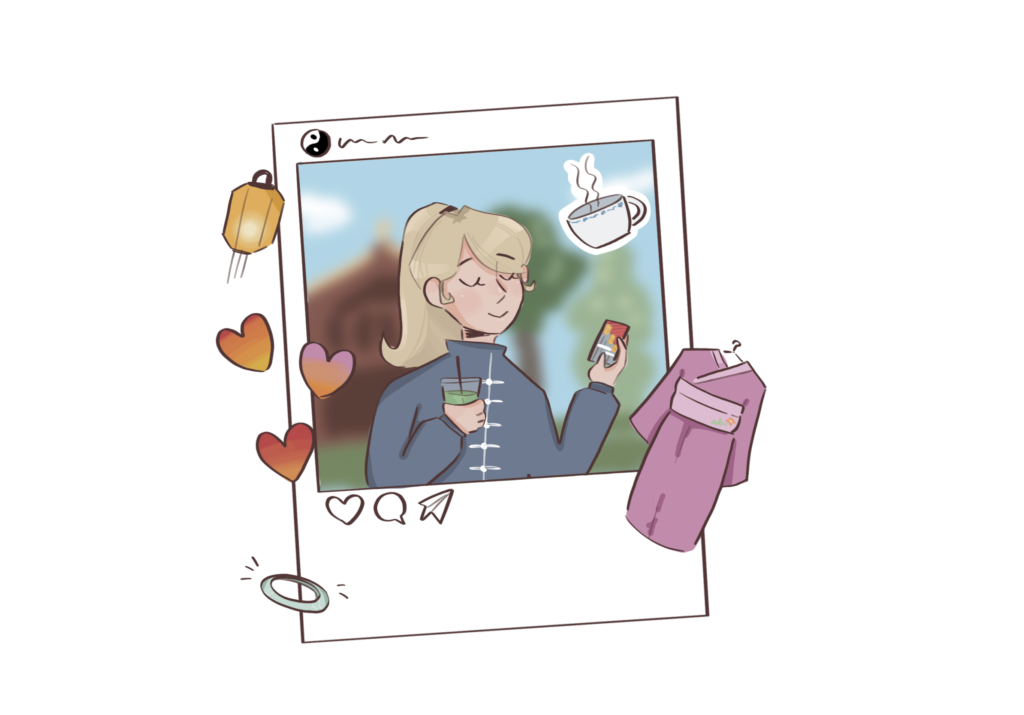
Scrolling aimlessly, a video pops up captioned, “I’m at a very Chinese time in my life.” In the video, an evidently not ethnically Chinese woman drinks hot water from a mug and walks around her house wearing indoor slippers. It’s unclear if the video is satire or serious, and the next four videos have the same obscure caption.
An increasingly popular social media trend is to partake in traditional Asian customs, many of which have Chinese origins. It’s a stark 180-degree-shift from the beginning of the decade, where Chinese-Americans were discriminated against after the rise of the coronavirus, as the first case of the disease was reported in China.
Following a long history of a disdain towards Asian-Americans, the 21st century takes on a reversal — Asian culture is suddenly viewed as desirable and even “trendy,” as seen in the popularization and, to some extent, westernization of Taiwanese boba, Japanese matcha, Filipino bebot makeup, K-pop and more.
“Some cultures [are] primarily just romanticized because some view them as aesthetic,” said junior Shamiksha Senthilkumar. “For instance, the slick back hairstyle: people started doing that [a lot], but in the past, it was considered unclean. [Slick backs] were a common thing in South Asian cultures, but now it’s romanticized, just because it fits [influencers’] current aesthetic and mood or personality.”
However, these trends are not completely harmful. Some even uplift and empower Asian communities, when done correctly and respectfully. For example, the bebot makeup trend has little discriminatory intent, instead elevating the Filipino community. Bebot, a slang term in the Philippines for a pretty woman, is used in this trend as a term of confidence, as creators do their makeup to embody Filipino ideals of beauty. It also seeks to embrace naturally tan skin colors, in rejection of the western ideals for fair skin that are prevalent in parts of Southeast Asia.
“For me, when I saw the bebot trend, I thought it was interesting, because it’s really rare to see Filipino culture being uplifted in media,” said junior Aeriel Crisostomo. “I thought it was nice, especially it being a beauty trend. As a kid, growing up in the Philippines, I’ve always liked to be lighter than I am. Even in my family, we would have whitening soaps and lotions. So seeing that, the bebot trend, it [feels] very accepting [towards] darker skin tones.”
It is difficult to define the difference between appropriation and appreciation, but what typically matters most is the intended impact of the content.
“It’s very convenient for influencers to just follow the trend and bandwagon, because they can just switch up later,” Crisostomo said. “A genuine intent [matters], not doing it for followers and likes, [rather] actually appreciating the culture behind it and the history. Asians shouldn’t just be interpreted as one [culture]; all of us have different historical backgrounds and I hope [influencers] take that into account.”
In addition, it is important to acknowledge the cultural background and history when partaking in these trends or promoting Asian traditions.
“When [people] use something from a different culture, they should acknowledge that it’s from a different culture, instead of just calling it a different name,” Senthilkumar said. “Such as Indian culture, [where] some [traditional] clothing was [mislabled as] Scandinavian, but when you search it up, it doesn’t look like Scandinavian clothing.”
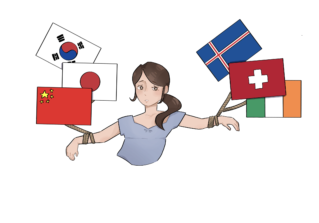
Another interesting aspect of these trends is not only its romanticization of Asian customs, but its ignorance of non-East Asian cultures. While countries like China, Japan and South Korea are looked upon favorably due to the influence of fashion like Adidas’ Tang jacket, or media like anime and manga, Asian nations in the Middle East and South are left in obscurity, potentially due to a bias created through media portrayals and diplomatic relations.
These trends popularizing Asian cultures have garnered mixed reactions and it remains unclear whether or not creators approach these fads with appreciation. While some communities have seen positive outcomes, others continue experiencing marginalization and the continuous struggle for racial equality exemplified by simple trend patterns and social media crazes.